Looped Tree
The clearance reblocker plus a bridge-tree loop-closure refiner: after the least-cost roads are placed, it greedily adds short connectors that remove bridges (single points of failure) from the network, up to a small budget share. The result keeps clearance's least-road efficiency while buying back the backup-route redundancy (internal connectivity) that pure trees lack.
Configuration: conf/method/loop_closure.yaml
Head-to-head on one deep block
From the method-comparison example: six reblockers on ZAF.9.3.1_1_40972, the deepest topology-tractable block in the Cape Town metro (263 parcels, up to 7 rings deep), graded on permeability (a flow measure of how easily every parcel can reach a street) against displacement.
At this method's full build-out on that block (terminal point of its permeability-vs-displacement frontier):
| homes displaced | permeability |
|---|---|
| 67.2% | 99.1% |
On the settlement-scale benchmark
From the Cape Town benchmark — the single-block, 6,619-parcel multiblock_depth_density region.
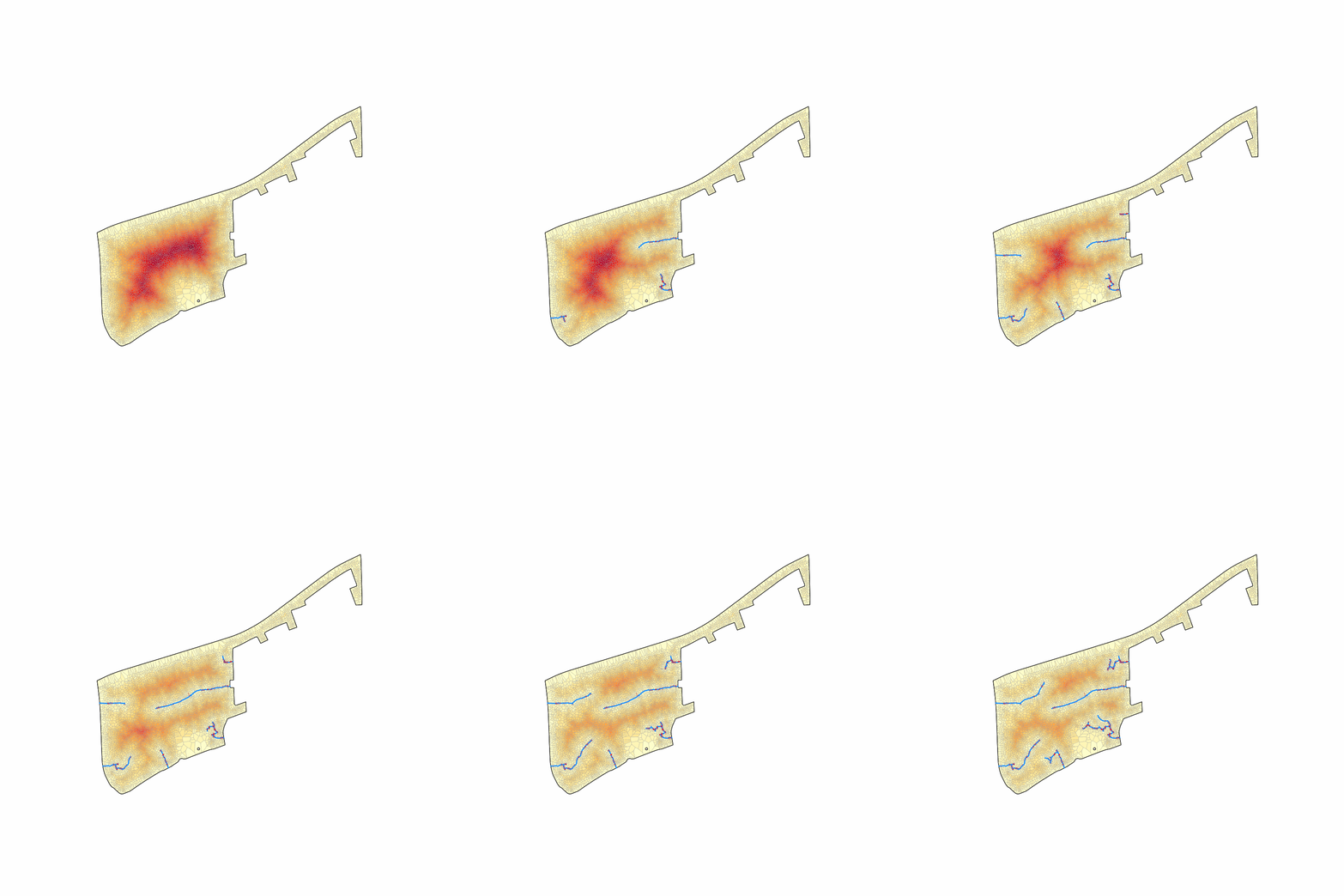
Roads added busiest-first, each preceded by whatever it needs to reach the street, so every frame is a network you could actually build. The animation stops where the network first reaches the matched-permeability standard — every method's GIF ends at the same benefit, so what differs is the disruption spent getting there. The deep interior drains as the network reaches in:
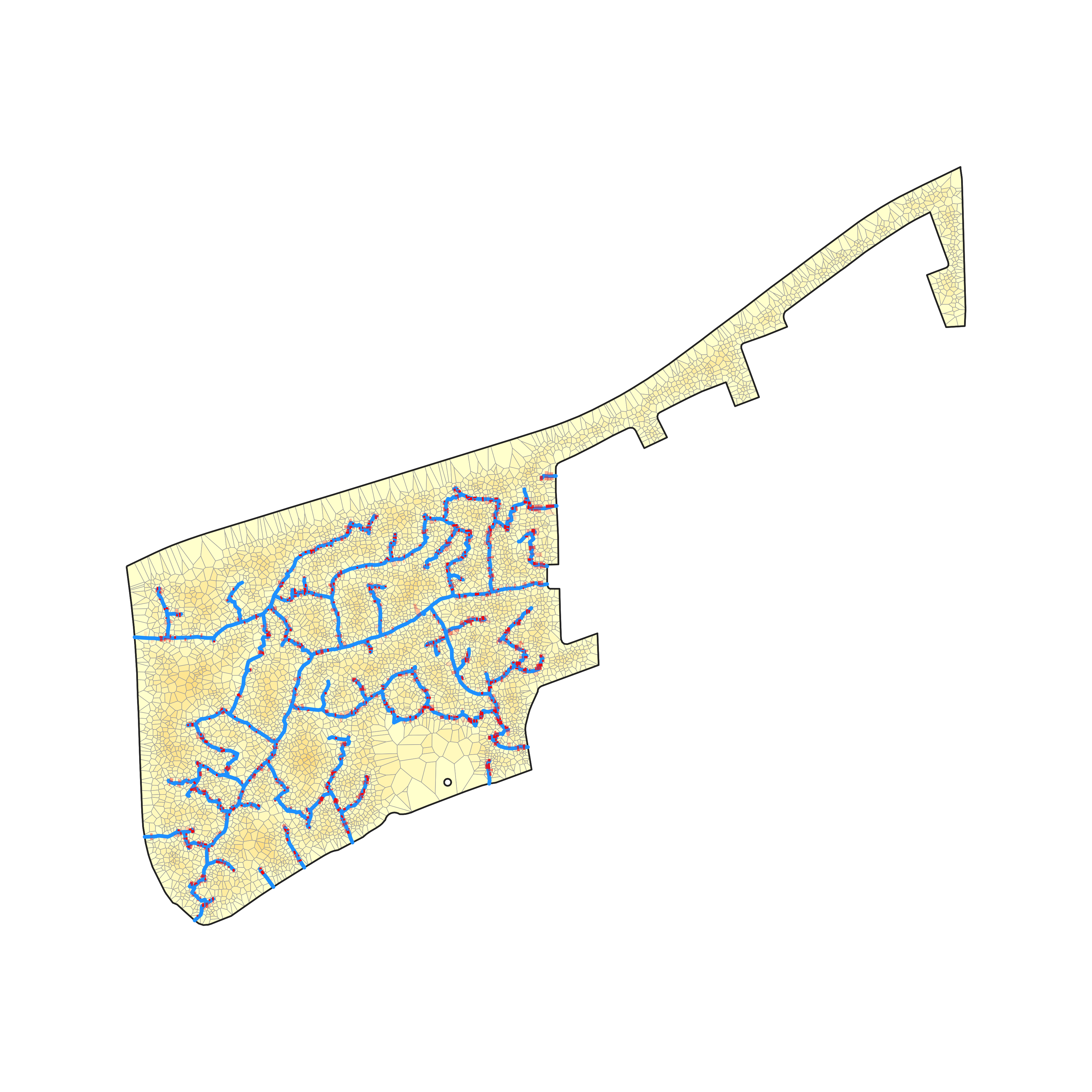
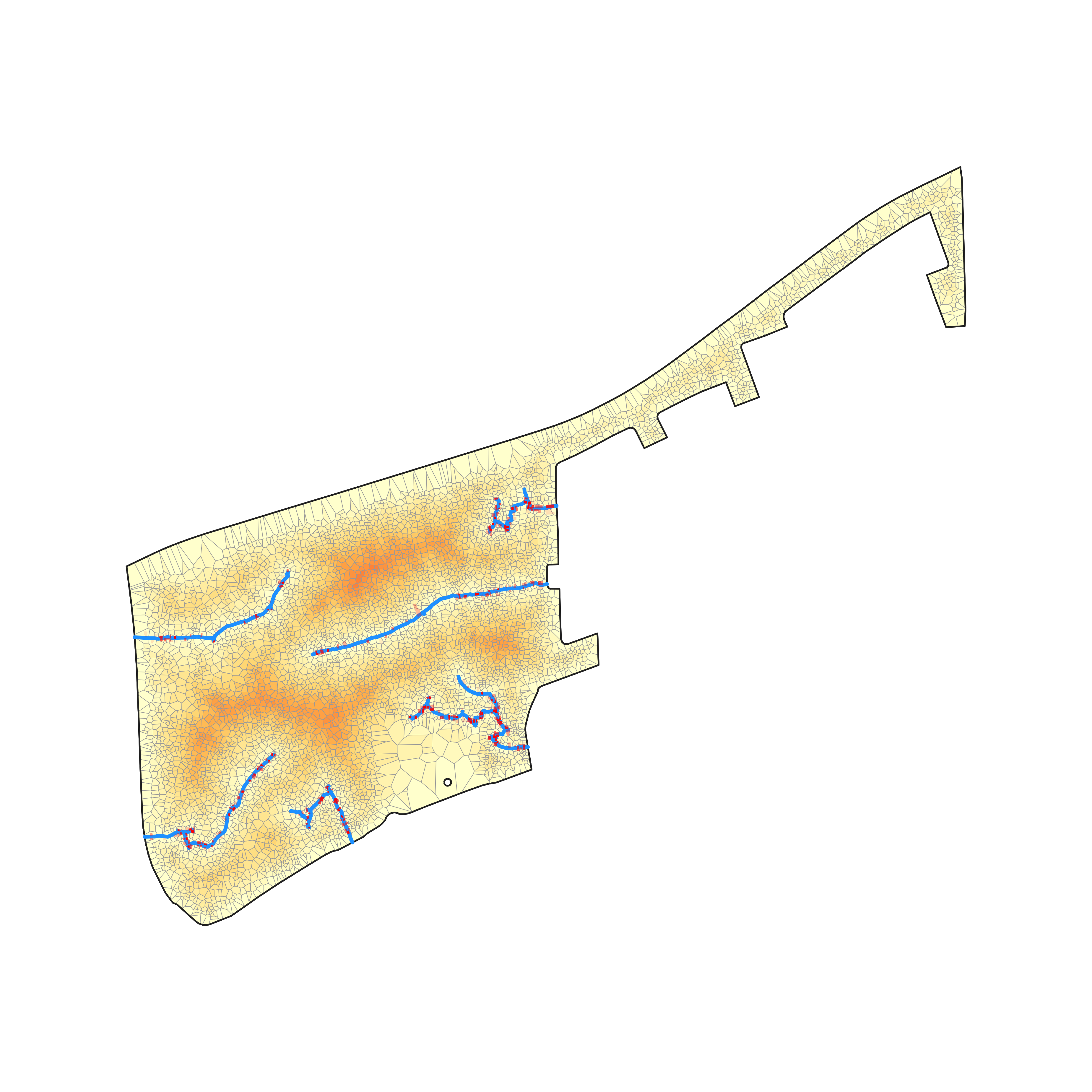
The same region under the two lenses — truncated to the shared displacement budget (left) and run until it reaches the shared permeability standard (right), coloured by access depth:
| matched displacement | matched permeability |
|---|---|
 |
 |
Matched displacement: at 7,997 m of road it reaches permeability 78.8%, displacing 10.1% of homes.
Matched permeability: reaches the permeability target with 2,297 m of road, displacing 2.8% of homes.