Frontage (street-priced)
Drives straight arterials, like the other Greedy Arterial variants, but optimises a different thing: the sum of squared access depths. Depth is how many of other people's plots you cross to reach a public street — the quantity the block-complexity literature treats as the definition of the slum deficit — and squaring it means the deepest dwellings dominate, so the method drives roads at whoever is worst served.
Two details earn their keep. It costs each candidate by displacement rather than by metres, which matters because displacement is the axis it is graded on: the same metres cost wildly different numbers of homes depending on where they run. And it is deliberately not run lazily — CELF's speedup needs a submodular objective, which holds for directness but not for access-burden reduction, where the lazy variant diverged from the exact greedy on every block tested and was slower on most of them.
What it draws looks like a plan rather than an accretion: a handful of long chords threading between buildings and spanning the block, where a least-cost tree grows many short stubs.
Configuration: conf/method/greedy_arterial.yaml
On the settlement-scale benchmark
From the Cape Town benchmark — the single-block, 6,619-parcel multiblock_depth_density region.
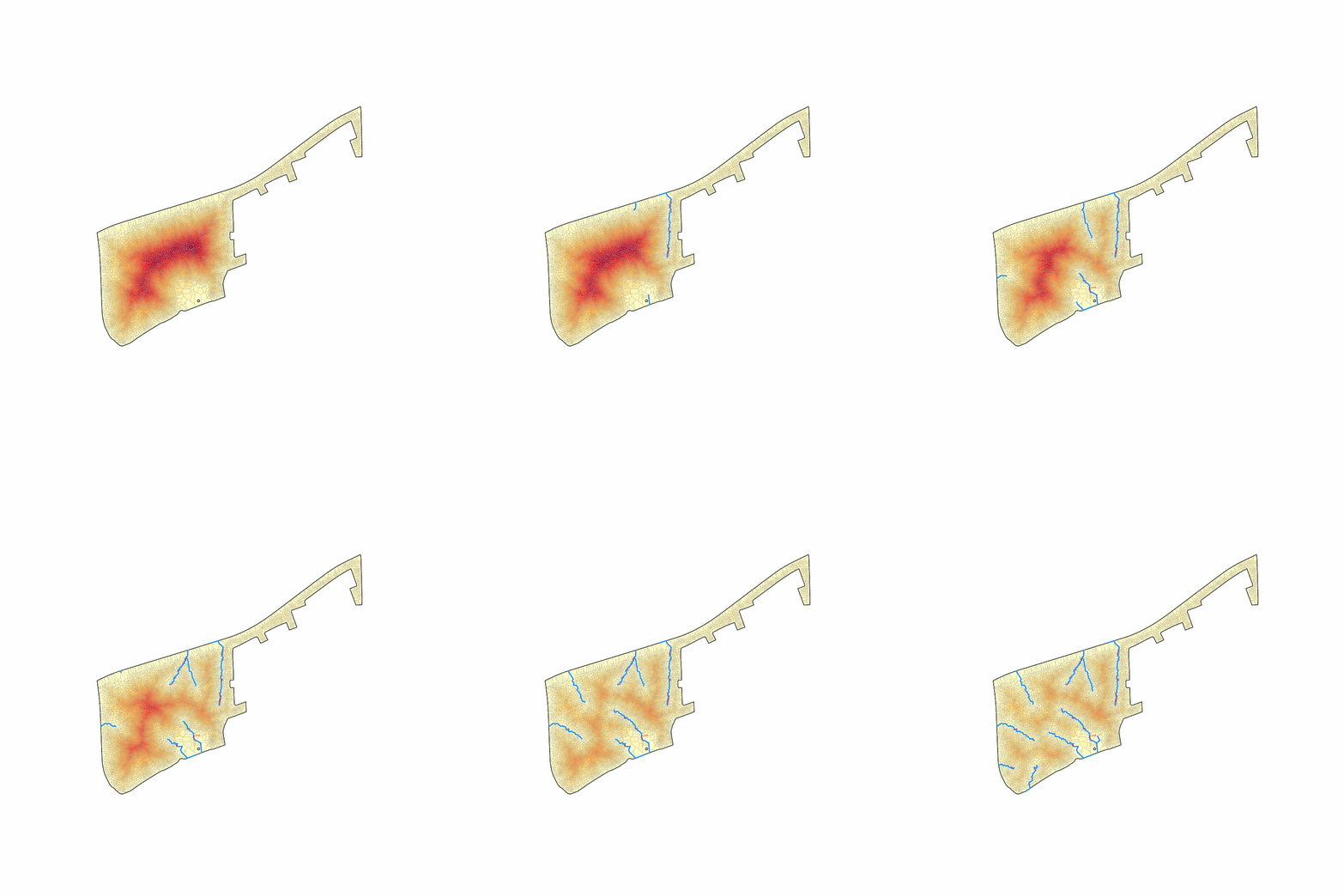
Roads added busiest-first, each preceded by whatever it needs to reach the street, so every frame is a network you could actually build. The animation stops where the network first reaches the matched-permeability standard — every method's GIF ends at the same benefit, so what differs is the disruption spent getting there. The deep interior drains as the network reaches in:
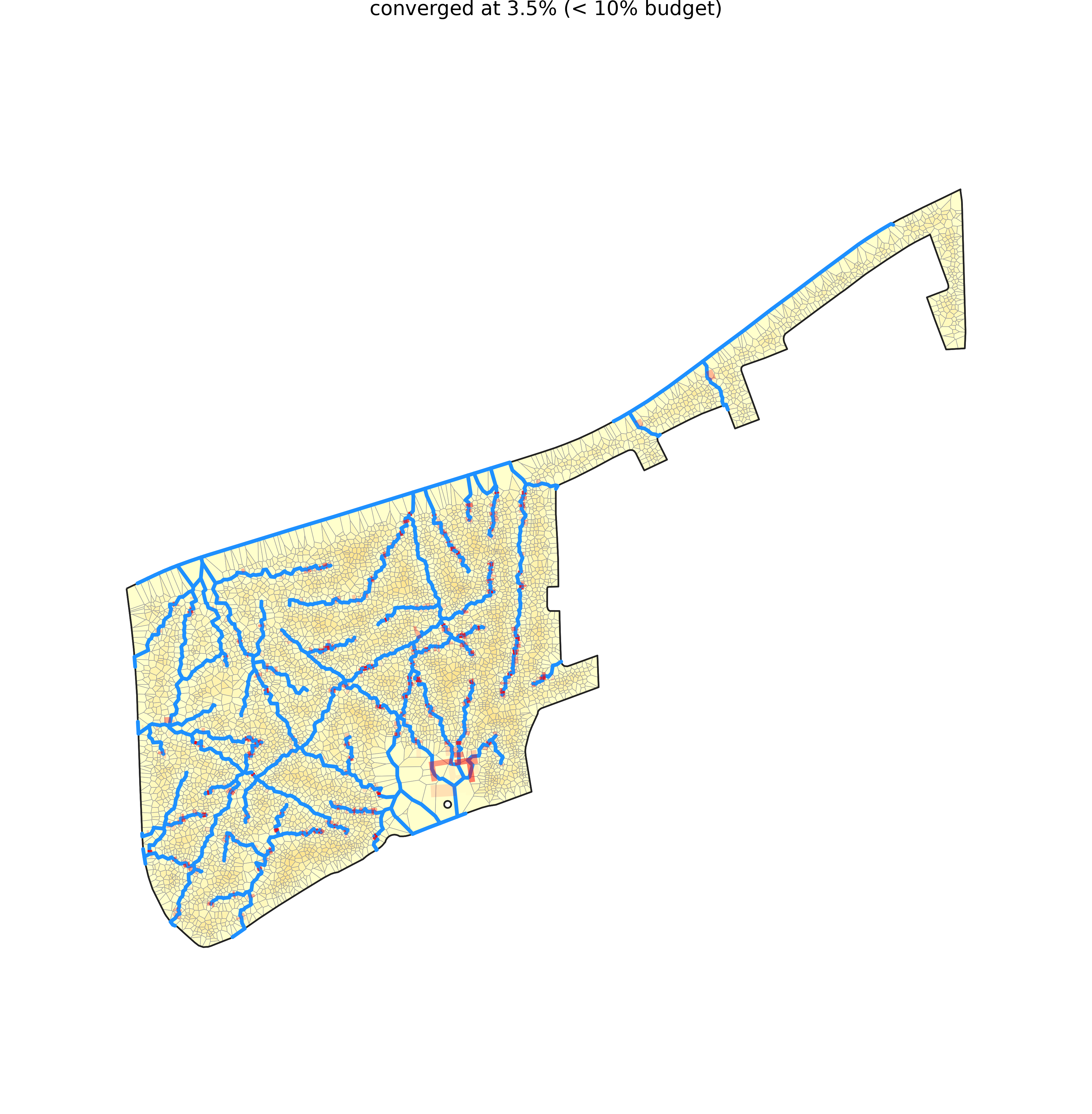
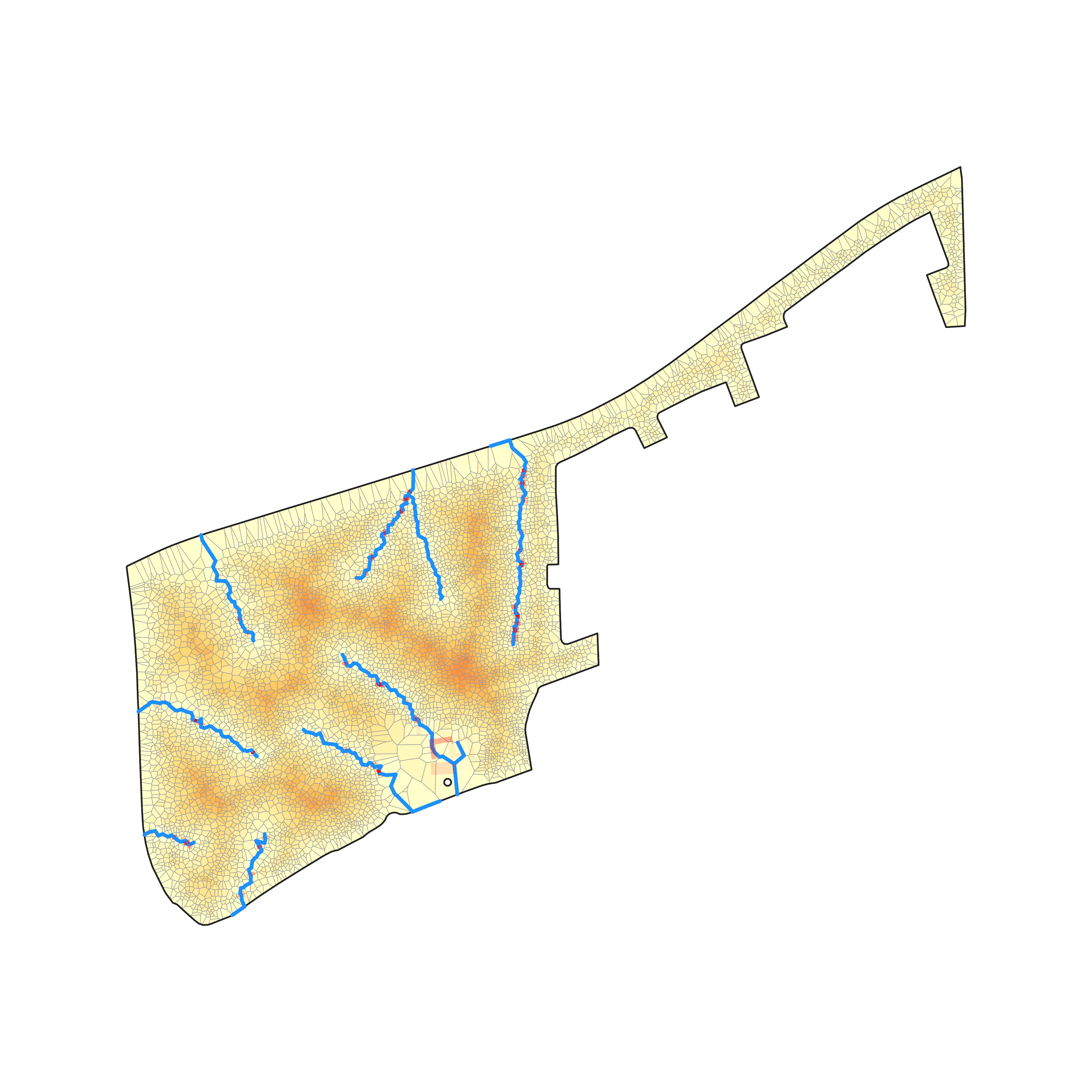
The same region under the two lenses — truncated to the shared displacement budget (left) and run until it reaches the shared permeability standard (right), coloured by access depth:
| matched displacement | matched permeability |
|---|---|
 |
 |
Matched displacement: at 11,592 m of road it reaches permeability 82.1%, displacing 3.5% of homes (it converges below the shared budget).
Matched permeability: reaches the permeability target with 2,677 m of road, displacing 0.8% of homes.