Loop Network
Makes the cycle the primitive instead of the spur. Every other reblocker grows a tree and then, at best, bolts connectors onto it; this one's atomic move is a LOOP — a path out from the street to a chosen parcel, plus a second path back that avoids the first one's edges, so the union is a genuine circuit rather than a there-and-back. Candidates are scored by permeability gain per home displaced, the same currency the lenses use.
The consequence is structural: it is bridgeless by construction, the only method here with essentially no single points of failure (bridge fraction ~0.03 against 0.51 for the looped tree and 1.00 for the grid and the LP). That property is real but currently invisible in the reported numbers, which price permeability and displacement only — so it reads as a strong second to the LP rather than as the different thing it is.
Configuration: conf/method/cycle_native.yaml
Head-to-head on one deep block
From the method-comparison example: six reblockers on ZAF.9.3.1_1_40972, the deepest topology-tractable block in the Cape Town metro (263 parcels, up to 7 rings deep), graded on permeability (a flow measure of how easily every parcel can reach a street) against displacement.
At this method's full build-out on that block (terminal point of its permeability-vs-displacement frontier):
| homes displaced | permeability |
|---|---|
| 19.9% | 95.6% |
On the settlement-scale benchmark
From the Cape Town benchmark — the single-block, 6,619-parcel multiblock_depth_density region.
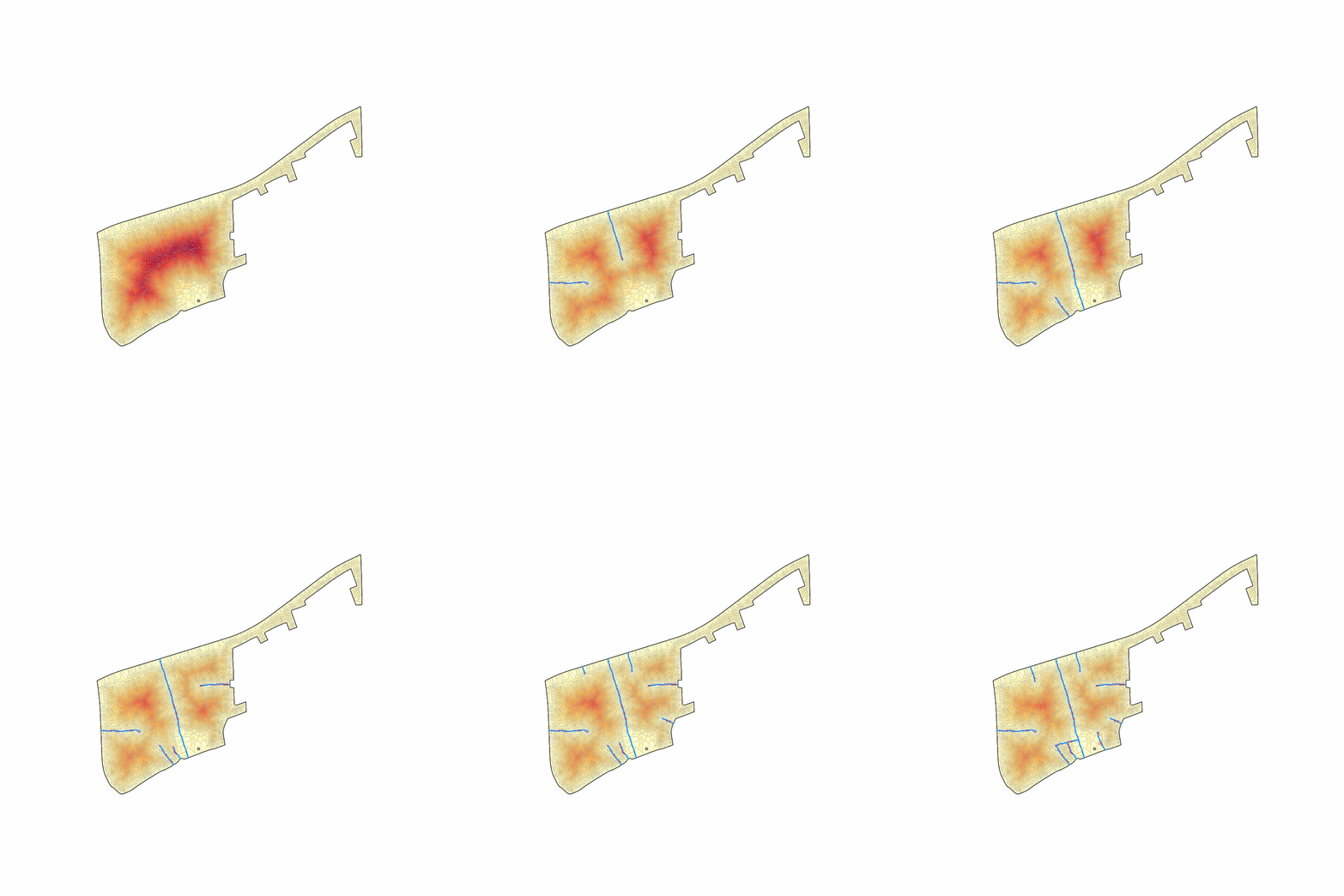
Roads added busiest-first, each preceded by whatever it needs to reach the street, so every frame is a network you could actually build. The animation stops where the network first reaches the matched-permeability standard — every method's GIF ends at the same benefit, so what differs is the disruption spent getting there. The deep interior drains as the network reaches in:
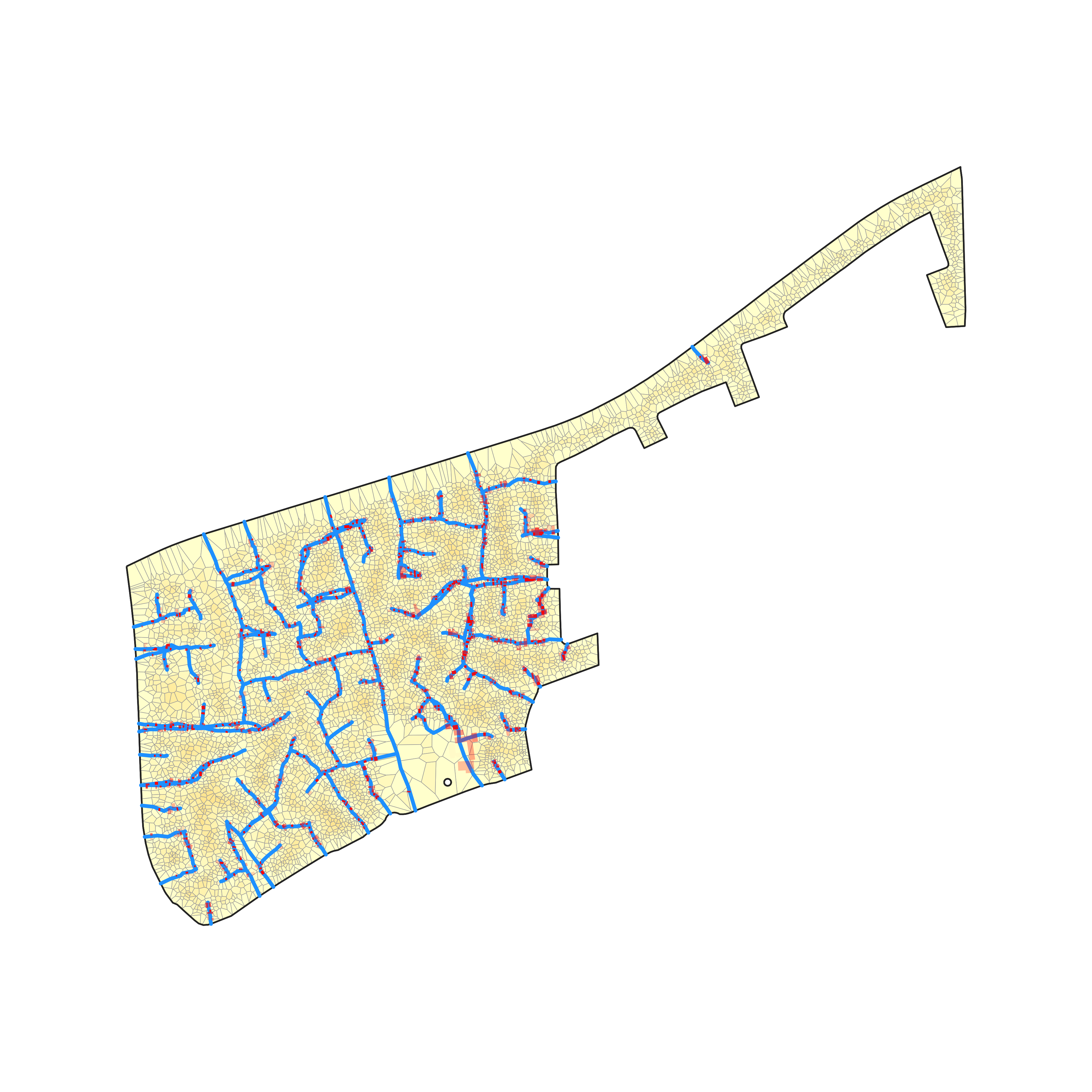
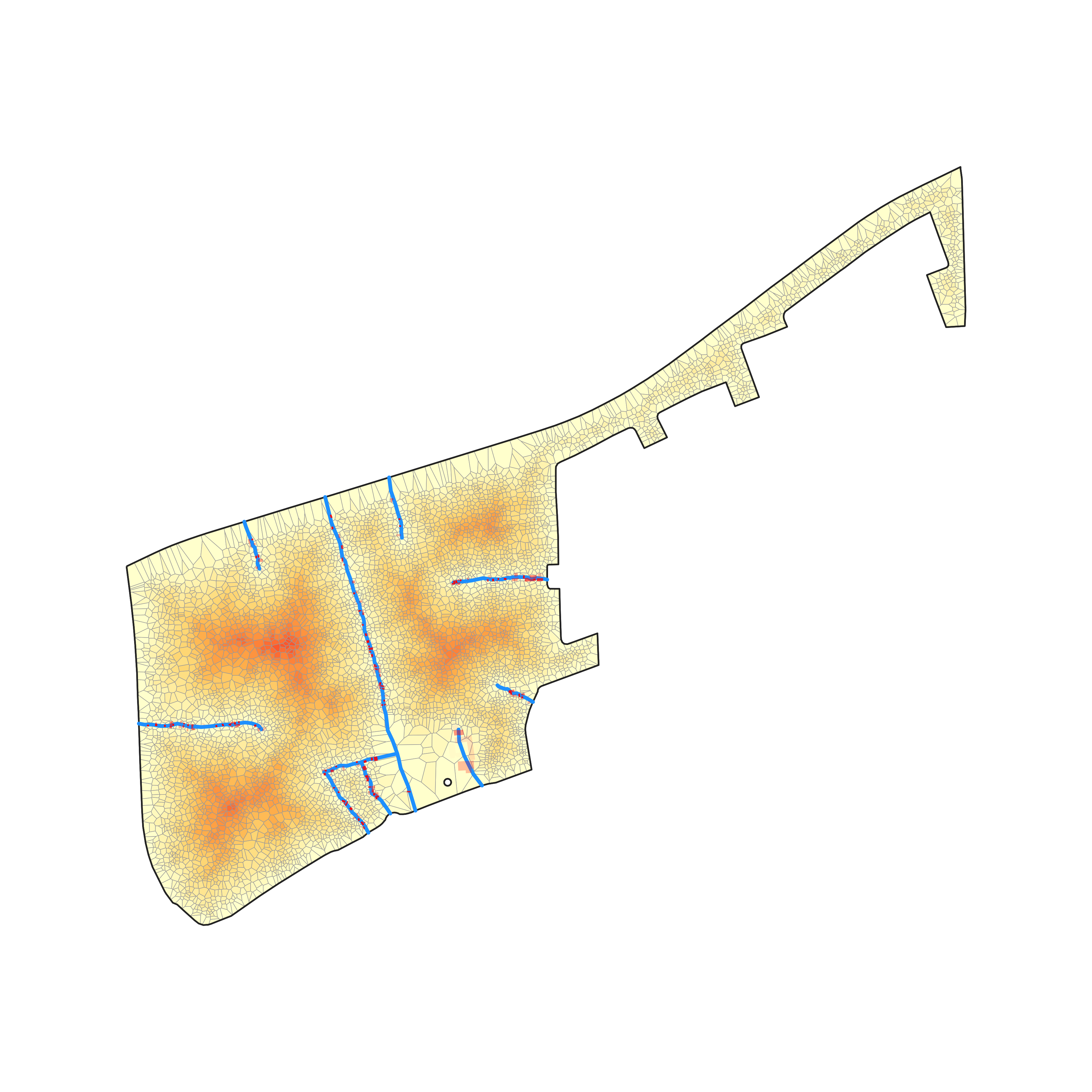
The same region under the two lenses — truncated to the shared displacement budget (left) and run until it reaches the shared permeability standard (right), coloured by access depth:
| matched displacement | matched permeability |
|---|---|
 |
 |
Matched displacement: at 10,348 m of road it reaches permeability 92.5%, displacing 10.0% of homes.
Matched permeability: reaches the permeability target with 1,817 m of road, displacing 1.7% of homes.